
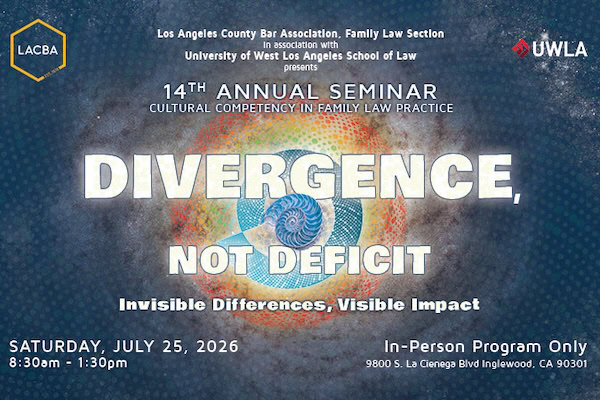
Family courts regularly encounter parents and children whose lives are shaped by autism, attention-deficit/hyperactivity disorder, learning differences, developmental diagnoses, mental health conditions, hearing loss, and other visible or invisible disabilities. Yet the legal system often approaches these differences through a narrow question: What is wrong? The 14th Annual Cultural Competency in Family Law Practice Seminar proposes a better question: What does this family need to be understood, supported and treated fairly?
“Divergence, Not Deficit,” a four-hour continuing legal education program presented on Sat., July 25, 2026, at the University of West Los Angeles, will bring together judges, attorneys, psychologists, financial professionals, educators and disability specialists for a focused examination of how disability and neurodiversity affect family relationships, custody disputes, communication, decision-making and access to justice. The program is designed not merely to define diagnoses, but to translate understanding into practical family law judgment.
The morning begins with registration and a continental breakfast courtesy of the French American Bar Association. Hon. Shelly L. Kaufman, supervising judge of the Los Angeles Superior Court Family Law Division; Tigran Palyan, chair of the LACBA Family Law Section; Steve S. Zand, associate dean and director of faculty development at the University of West Los Angeles; and seminar founder and organizer Abbas Hadjian will welcome attendees and introduce the day’s central theme.
Panel I: Neurodivergent parents and children
The first panel, “Neurodivergent Parents and Children in Family Court,” will be presented by Daniel B. Pickar, Ph.D., ABPP, and moderated by family law attorney Michael J. Kretzmer, past president of the AFCC California Chapter and a certified family law specialist.
Pickar is a board-certified child psychologist who conducts parenting-plan evaluations, provides consultation to family law attorneys and performs psychoeducational evaluations of children. For 12 years, he served as division chief of child and family psychiatry at Kaiser Permanente Medical Center in Santa Rosa. He has published more than 30 journal articles and book chapters on child custody evaluation, mediation, and neurodivergent children in divorce, and he regularly teaches at AFCC and AAML conferences. His work has been recognized with the Judge Rex Sater Award for Excellence in Family Law and, in 2026, the California Lawyers Association Family Law Section’s Excellence in Family Law Award.
Pickar’s presentation will address the diagnostic conditions commonly included under the neurodiversity and disability umbrella, as well as the stigma and bias that parents may encounter in court. He will discuss risk-assessment models for parenting plans, methods for representing a neurodivergent parent, the importance of listening to the voice of a child who may have language or developmental impairments, and strategies for resolving parental disputes about diagnosis, treatment, medication, education or care.
Panel II: Impact of disabilities
The second panel, “Impact of Disabilities on Family Dynamics,” brings a deliberately multidisciplinary perspective. Hon. Mark A. Juhas of the Los Angeles Superior Court Family Law Division will provide the judicial viewpoint. Lorna Mouton Riff, CPA, CFF, a lead managing director with CBIZ FCG LLC, will address the emotional and financial realities that may accompany disability, including ongoing care, specialized services, support needs and long-term planning. Alison Freeman, Ph.D., a clinical psychologist and hearing-loss specialist, will examine communication barriers that are often misunderstood as resistance, indifference or lack of credibility. Dr. Gitu Bhatia, a licensed clinical psychologist with extensive experience in family systems and divorce-related conflict, will add the clinical and cultural dimensions of disability within the family.
Together, these speakers will explore an important truth: Disability rarely affects only one person. It can alter family roles, financial expectations, communication patterns, caregiving responsibilities and the ability to participate fully in litigation. Lawyers and courts must be able to distinguish disability-related behavior from poor parenting, noncooperation or intentional misconduct.
Panel III: The intersection of mental health or developmental diagnosis
The third panel, “The Intersection of Mental Health or Developmental Diagnosis and Family Law,” will feature Hon. Michael J. Convey, psychologist Carol R. Hirshfield, Ph.D., and attorney Sophia Bliziotis.
Judge Convey has served in the Family Law Division since 2002, first as a commissioner and, since his 2010 appointment, as a judge. His experience includes more than a decade in dedicated family law trial assignments and more than 12 years in general-jurisdiction family law courts throughout Los Angeles County. His long service gives him a practical perspective on how courts receive, evaluate, and apply mental health and developmental evidence.
Hirshfield is licensed in California and Washington and has more than 25 years of experience working with children, adults and families. Her specialties include child development, learning disabilities, attention-deficit/hyperactivity disorder, developmental disabilities, autism, anxiety, obsessive-compulsive disorder and high-conflict divorce. Her work includes family therapy, parenting and co-parenting counseling, custody mediation, collaborative divorce coaching and child-specialist services. She has also trained lawyers and mental health professionals on children with special needs, the voice of the child, co-parenting, reunification and multidisciplinary practice.
Sophia Bliziotis, a partner at Vanaman German LLP, is an established authority in special-education law and litigation. She represents parents in mediations and administrative hearings, assists with educational planning and Regional Center Individual Program Plan proceedings, and has prior experience in Mental Health Court and family law, including minors’ counsel matters. Her participation will help connect diagnosis to enforceable educational rights, available services and effective advocacy.
Lunch with your family law judge
The program concludes with “Lunch with Your Family Law Judge” and a roundtable at 12:30 p.m. Participants include Commissioner Marc Bertet, Commissioner Suzanne Blossom, Hon. Emily J. Cole, Hon. Holly Hancock-Goode, Hon. Joel Lofton, Commissioner Sarah Reisman, Commissioner David K. Schultz and Commissioner Kendra Thomas. Hon. Firdous Dordi will serve as judicial moderator, with Tigran Palyan as attorney moderator.
This informal exchange will give practitioners an unusual opportunity to hear directly from judicial officers serving in home courts, restraining-order courts, and other family law departments.
“Divergence, Not Deficit” reflects the larger purpose of cultural competency: to recognize that fairness requires more than treating everyone identically. It requires understanding how a person communicates, processes information, experiences stress, cares for a child and participates in the legal system.
For family law professionals, that understanding is not an optional courtesy. It is an essential part of competent advocacy, informed decision-making and meaningful access to justice.
Hadjian, Abbas. (2026, July 22). Divergence, Not Deficit: Disability and Neurodiversity in Family Court. The Daily Journal. https://www.dailyjournal.com/articles/393335-divergence-not-deficit-what-family-law-must-learn-about-neurodiversity-and-disability